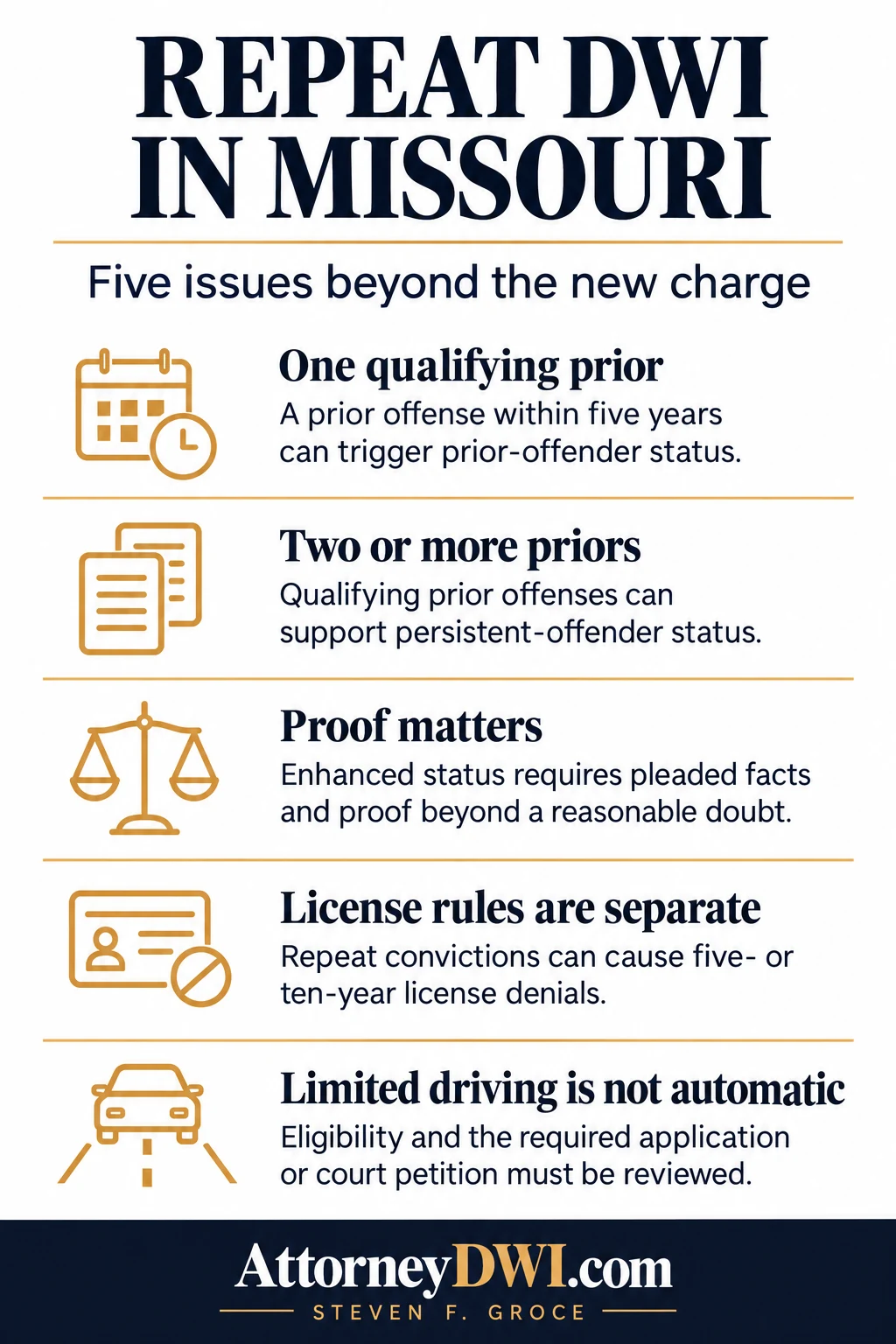
A second or subsequent DWI can carry considerably greater consequences than a first offense. If you have a prior intoxication-related offense and are arrested again in Springfield, your history can affect how the new charge is classified, the potential penalties you face, and what happens to your Missouri driving privileges.
Springfield repeat DWI lawyer Steven F. Groce has practiced law since 1984, with DWI defense serving as a major focus of his criminal practice. He represents people facing second, third, and subsequent DWI charges in Springfield, Greene County, and throughout Southwest Missouri.
Defending a repeat DWI requires careful attention to both the new arrest and the defendant's prior record. Steven examines the traffic stop, officer observations, field sobriety exercises, chemical testing, video evidence, and other circumstances surrounding the current charge. He also reviews the prior intoxication-related offenses prosecutors may rely on to increase the seriousness of the case.
Having a prior DWI does not eliminate your right to defend yourself against a new allegation. Steven works to determine what the prosecution can actually prove and what defense options may be available based on the facts of your case.
Missouri law treats repeat DWI offenses more seriously than a typical first offense. Prior intoxication-related offenses can affect the classification of a new charge, potential sentencing, and other consequences. As a result, determining exactly what appears in a defendant's prior record is an important part of repeat DWI defense.
Missouri uses several offender classifications when addressing defendants with qualifying prior intoxication-related offenses. Depending on the person's history and circumstances, these can include prior, persistent, aggravated, chronic, and habitual offender classifications. These classifications can become increasingly serious as qualifying prior offenses accumulate or other aggravating factors are present.
When Steven reviews a repeat DWI case, relevant questions may include:
This is why the number of times someone remembers being arrested for DWI does not necessarily provide a complete picture of the new case. The legal significance of prior offenses requires closer examination of the actual record.
Prior history also does not prove the new DWI allegation. Prosecutors must still establish that the defendant committed the current offense. Steven therefore examines both parts of the case: whether the evidence supports the new Springfield DWI charge and whether the prior record supports the enhanced classification prosecutors are seeking.
A second DWI can create greater criminal and driver's license concerns than a first offense. When a qualifying prior intoxication-related offense exists, Missouri law can increase the classification and potential consequences of the new charge.
For someone arrested for a second DWI in Springfield, that makes it important to understand exactly how the prior case affects the new prosecution.
Is a Second DWI a Misdemeanor or Felony in Missouri?
A second DWI is not automatically a felony. When a defendant has one qualifying prior intoxication-related offense and meets Missouri's definition of a prior offender, the new DWI is generally prosecuted as a Class A misdemeanor.
More extensive prior history or certain circumstances surrounding the current offense can expose a defendant to felony charges. That is why an attorney should review the actual record rather than determining the seriousness of the case solely by counting arrests.
Steven can examine the prior offense prosecutors intend to use and determine how it affects the classification of the new DWI.
Potential Consequences of a Second DWI
A second DWI can expose a defendant to more serious consequences than a typical first offense. Depending on the circumstances, concerns may include:
Missouri also places additional restrictions on sentencing for certain repeat DWI offenders. Depending on the applicable classification and circumstances, a defendant may face minimum incarceration requirements or statutory alternatives involving community service or treatment.
These potential consequences make the defense of the current charge particularly important. A prior DWI does not make officer observations, field sobriety exercises, breath or blood testing, or other evidence from a new arrest immune from challenge.
Steven F. Groce examines what happened during the current Springfield DWI investigation while also reviewing the prior offense being used against his client. This allows the defense to address the new allegation and the increased consequences associated with repeat-offender status.
Third and Subsequent DWI Charges in Missouri
The stakes can rise substantially when someone accused of DWI has multiple qualifying prior intoxication-related offenses. Depending on the defendant's history and the circumstances of the current case, a third or subsequent DWI may expose the person to felony prosecution.
Missouri uses progressively more serious offender classifications as qualifying prior offenses and aggravating circumstances increase. This means a defendant facing another DWI may need to understand not only whether the current allegation can be proven, but also why prosecutors believe a particular repeat-offender classification applies.
Important issues can include:
A third DWI should therefore not be viewed simply as a second DWI with another penalty added. Once felony exposure becomes an issue, the potential effects on a defendant's freedom, criminal record, driving privileges, employment, and future can become considerably more serious.
As a Springfield repeat DWI attorney, Steven represents defendants facing second, third, and subsequent intoxicated-driving charges. He examines the prior record and the current arrest separately to determine what the prosecution can establish in each area.
Our dedicated felony DWI content will address Missouri felony DWI classifications in greater depth. For someone facing another DWI now, the immediate concern is determining what level of charge prosecutors are pursuing, why they believe the defendant qualifies for that charge, and what defenses may be available.
A repeat DWI case is different from a first-offense prosecution because Steven may need to examine evidence from two separate periods: the current arrest and the defendant's prior history. Prosecutors seeking increased penalties based on previous intoxication-related offenses must be able to establish the prior record they are relying upon.
That makes reviewing those earlier cases an important part of defending a second, third, or subsequent DWI.
Depending on the circumstances, Steven may examine:
A defendant's own recollection of an old case may not provide enough information to determine how it affects a new DWI. Someone may remember being arrested years ago without knowing exactly how the case was ultimately resolved or how Missouri law treats that prior offense today.
The prosecution's characterization of the record should not simply be accepted without review either. When prior offenses are being used to increase the seriousness of a new Springfield DWI charge, Steven can examine whether the available records support the classification prosecutors are seeking.
This does not replace the need to defend the current arrest. Even when the defendant has qualifying prior offenses, prosecutors still need evidence to prove the new DWI allegation.
For Steven, these are two connected but distinct parts of repeat DWI defense. He evaluates whether the current evidence establishes DWI while also determining whether the prior record supports the increased consequences the prosecution is pursuing.
Another DWI arrest can create serious concerns about your ability to continue driving. For someone who relies on a vehicle to work, care for family members, or manage everyday responsibilities in Springfield and Greene County, the loss of driving privileges can have immediate practical consequences.
A repeat DWI may involve license issues related to the current arrest as well as the driver's prior history. Relevant factors can include chemical test results, an alleged refusal to submit to testing, previous DWI convictions, and earlier actions against the person's driving privileges.
Depending on the case, a repeat DWI defendant may need to address:
SpringfieldDWI license suspension attorney Steven F. Groce helps clients understand how an intoxicated-driving arrest may affect their ability to drive and what options may be available based on their circumstances.
Driver's license matters can involve procedures and deadlines separate from the criminal DWI prosecution. For repeat offenders, prior history can make those issues more complicated. Steven evaluates the license consequences alongside the criminal charge so that an important part of the case is not overlooked.
Prior DWI offenses can increase the stakes of a new case, but they do not make the current allegation impossible to defend. A repeat DWI charge can raise potential issues involving both the evidence from the new arrest and the prior record prosecutors intend to use for an enhanced classification.
Steven examines the current Springfield DWI investigation on its own merits. Depending on the facts, that review can include:
Prior DWI convictions do not make evidence from a new arrest automatically reliable. If video conflicts with an officer's description, testing raises legitimate questions, or the traffic stop presents a legal issue, those circumstances deserve examination regardless of the defendant's history.
Steven also reviews the basis for the repeat-offender classification prosecutors are seeking. The existence and legal significance of prior intoxication-related offenses can affect whether a new DWI remains a misdemeanor or exposes the defendant to felony prosecution.
This creates two central questions in many repeat DWI cases:
A strong defense requires attention to both. Successfully challenging an aspect of the current investigation may affect the underlying DWI prosecution, while questions concerning the prior record may affect the level of charge or potential consequences.
As a Springfield repeat DWI lawyer, Steven evaluates these issues individually rather than assuming that a defendant's history determines the outcome of the new case. The goal is to understand exactly what prosecutors can prove and build the defense around the evidence that actually exists.
Chemical test results can become important evidence in a repeat DWI prosecution, but a reported BAC or blood test result should still be evaluated within the context of the complete investigation. Prior DWI history does not eliminate questions about how evidence from the current arrest was obtained or whether it supports the prosecution's allegations.
Depending on the case, Steven may examine the timing of chemical testing, the procedures used, relevant testing records, and the collection or handling of blood evidence. Steven'sMissouri blood alcohol concentration information provides additional background on alcohol consumption and BAC levels.
Chemical evidence can also be compared with other information from the Springfield DWI investigation, including officer observations, video footage, field sobriety exercises, and the timeline surrounding the arrest.
When a repeat offense exposes a defendant to greater consequences, careful review of the evidence supporting the new charge becomes particularly important. Steven evaluates chemical testing as one part of the overall case rather than assuming that a single number determines the outcome.
Defending a repeat DWI requires attention to issues that may not exist in a typical first-offense case. The prosecution may be relying on both new evidence of alleged intoxication and an established history of prior offenses to pursue more serious consequences.
That can make repeat DWI cases more complicated in several ways:
These differences make it important to identify which issues actually affect the individual case. A second DWI involving a disputed traffic stop may require a different approach from a third offense involving questions about chemical testing or the classification of prior convictions.
Steven F. Groce builds the defense around those individual circumstances. His review can address weaknesses in the current DWI evidence while also examining whether prosecutors can establish the repeat-offender status they allege.
A prior record can make a new DWI more serious, but it should not replace careful analysis of the current charge. As a Springfield repeat DWI attorney, Steven focuses on the evidence prosecutors have, the classification they are pursuing, and the defense options available under the circumstances.
When you are facing another DWI, experience with intoxication-related cases can be particularly valuable. Repeat DWI charges may involve enhanced penalties, prior-offender classifications, driver's license problems, and potential felony exposure that make the consequences substantially different from those associated with a typical first offense.
Steven F. Groce has practiced law since 1984, and DWI defense has long been a major focus of his Springfield criminal practice. He represents people accused of second, third, and subsequent DWI offenses in Springfield, Greene County, and throughout Southwest Missouri.
Clients facing repeat DWI charges can turn to Steven for:
More than four decades of legal experience cannot guarantee a particular result. It does provide Steven with substantial experience evaluating DWI allegations and identifying the issues that can become particularly important when a defendant has prior offenses.
For someone accused of another DWI in Springfield, effective representation should look beyond the label of "repeat offender." Steven examines what happened during the new arrest, what the defendant's prior record actually establishes, and how those two parts of the case affect the defense moving forward.
What happens if I get a second DWI in Missouri?
A second DWI can carry greater consequences than a typical first offense. If a qualifying prior intoxication-related offense exists, the new charge may be classified more seriously and can involve increased criminal penalties and driver's license consequences. Steven reviews both the prior record and the evidence from the new Springfield DWI arrest to determine what charges and consequences his client actually faces.
Is a third DWI a felony in Missouri?
A third DWI can result in felony prosecution when the defendant's qualifying prior history supports a felony repeat-offender classification. However, simply counting the number of times someone has been arrested does not necessarily determine the classification. The nature and disposition of prior intoxication-related offenses and the circumstances of the current case must be evaluated.
How do prior DWIs affect a new Missouri DWI charge?
Qualifying prior intoxication-related offenses can affect the classification of a new DWI, potential sentencing, and driver's license consequences. The more extensive the qualifying history, the more serious the potential charge can become. Steven examines the records prosecutors are relying upon rather than assuming their characterization of the defendant's history is automatically correct.
Can an old DWI be used against me in Missouri?
Prior intoxication-related offenses may be relevant to a new Missouri DWI case depending on the nature of the prior offense and applicable law. A Springfield repeat DWI attorney can review older court and driving records to determine whether and how prosecutors may use them when pursuing an enhanced classification.
Can a repeat DWI charge be reduced or dismissed?
A repeat DWI may be reduced or dismissed in some circumstances, but no attorney can guarantee either outcome. The possibilities depend on the evidence, applicable law, prior history, and circumstances of the current arrest. Issues involving the traffic stop, chemical testing, officer observations, admissibility of evidence, or the alleged repeat-offender classification may affect how the case is ultimately resolved.
Another DWI arrest can carry substantially greater consequences when you already have intoxication-related offenses on your record. Understanding exactly how those prior cases affect the new charge is an important part of determining how to move forward.
Steven F. Groce, Attorney at Law has practiced law since 1984 and brings more than four decades of experience to DWI defense in Springfield, Greene County, and throughout Southwest Missouri. He represents people facing second, third, and subsequent DWI allegations, including cases that may expose defendants to felony charges and increased driver's license consequences.
If you have been arrested for another DWI, contact Steven F. Groce, Attorney at Law to discuss your case with an experienced Springfield repeat DWI lawyer. Steven can review the evidence surrounding your current arrest, examine the prior offenses prosecutors intend to use against you, explain the potential consequences, and help you determine your options for defending the charge.