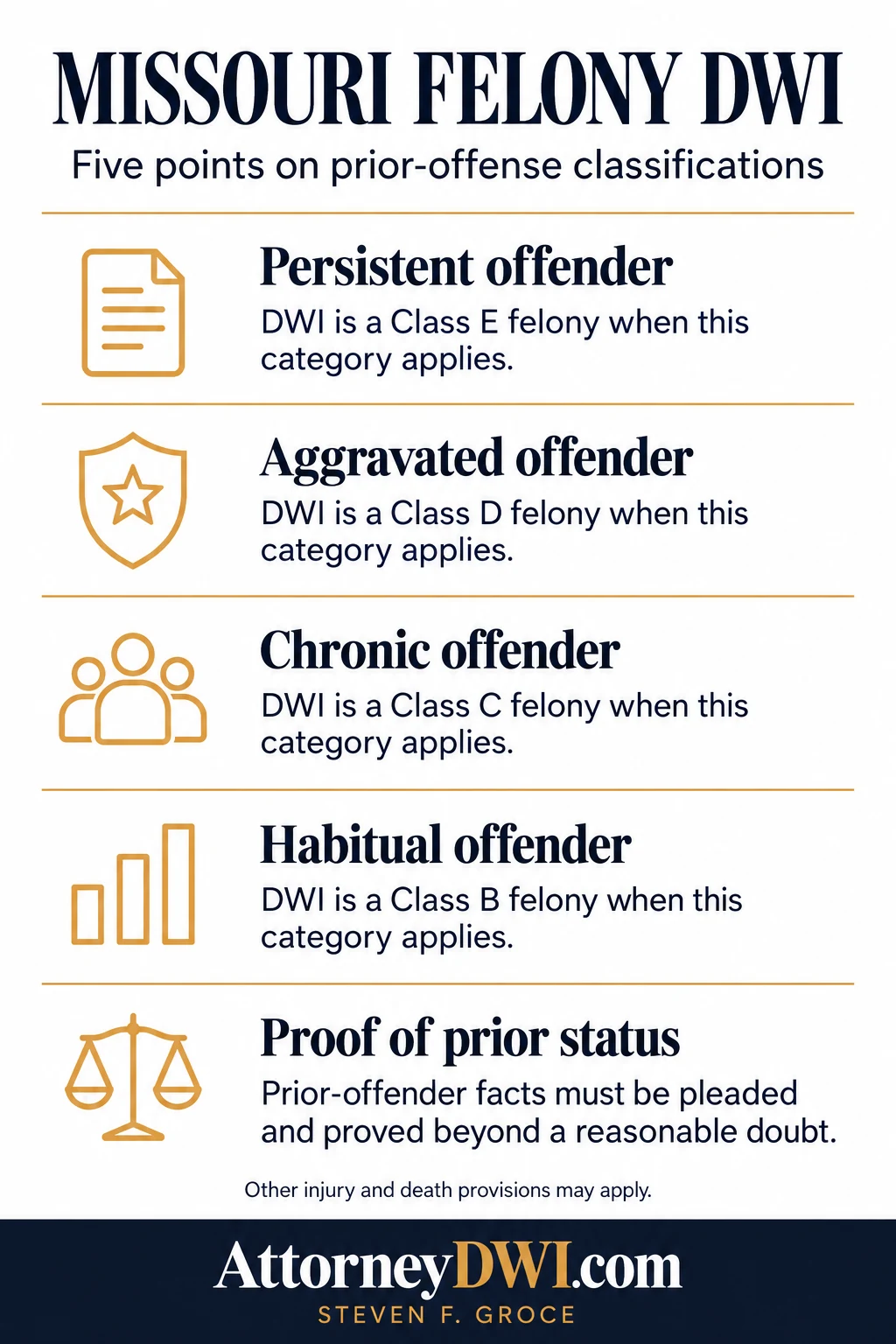
When a felony DWI is based on repeat-offender status, prior intoxication-related offenses become a central part of the prosecution's case. The government may rely on previous findings of guilt to establish that the defendant qualifies for a felony offender classification.
Steven does not simply assume that the prosecution's description of a defendant's history is complete or correct. He can examine the underlying records and determine how the prior cases affect the current charge.
That review may involve:
- Prior DWI court records;
- Missouri driving records;
- The disposition of earlier intoxication-related cases;
- The number of qualifying prior offenses;
- Out-of-state offenses prosecutors intend to rely upon; and
- Whether the documented history supports the felony classification alleged.
The distinction between the underlying DWI and its felony classification is important. Prosecutors must have evidence supporting the current allegation of intoxicated driving, while also establishing the prior history necessary for a repeat-offender enhancement when that is the basis for the felony charge.
This means a felony DWI defense may involve challenging different aspects of the prosecution's case. Steven can examine what happened during the new Springfield DWI arrest while separately reviewing the prior offenses being used to increase the seriousness of the charge.
Legal Issues That May Affect a Felony DWI Case
A felony charge does not eliminate a defendant's right to challenge the evidence. In fact, the increased consequences of felony prosecution make careful examination of the government's case particularly important.
Felony DWI cases can present different legal and factual issues depending on whether the felony classification is based on prior intoxication-related offenses, circumstances involving injury or death, or other aggravating factors. An effective defense requires consideration of both the underlying DWI allegation and the basis for elevating the offense to a felony.
Challenging the Current DWI Allegation
One important question is whether prosecutors can prove the underlying DWI. Depending on the circumstances, relevant issues may include:
- Whether law enforcement had lawful grounds for the traffic stop;
- Police reports and officer observations;
- Body camera and dashboard camera footage;
- Field sobriety exercises and how they were administered;
- Breath, blood, or other chemical testing;
- Evidence of alleged drug-related impairment;
- Searches of the defendant or vehicle;
- Statements allegedly made to law enforcement; and
- Evidence concerning a collision, injury, or other aggravating circumstances.
A defendant's prior history does not make evidence from the current arrest automatically reliable. Issues involving the stop, testing, officer observations, or admissibility of evidence can remain relevant even when someone has multiple prior DWI offenses.
Challenging the Basis for Felony Classification
A felony DWI case can also require careful consideration of why prosecutors believe the offense qualifies for felony treatment.
In a repeat-offender case, prior court and driving records may become important when determining whether the defendant's history supports the classification being alleged. The existence of prior DWI arrests alone does not eliminate the need to establish the qualifying history required for the charge.
Cases involving injury or death can present different questions. Relevant evidence may concern how the collision occurred, the nature of the alleged injuries, the defendant's alleged intoxication, and whether prosecutors can establish the connection necessary to support the charged felony offense.
A Springfield felony DWI lawyer may therefore need to consider two fundamental issues: whether the government can prove the underlying DWI and whether it can establish the additional facts necessary to prosecute the offense at the felony level.
Steven F. Groce brings more than four decades of legal experience to representing people facing serious DWI allegations in Springfield and throughout Southwest Missouri. He can help defendants understand the felony charge against them, the evidence involved, and the legal options available based on the circumstances of their case.
Breath and Blood Testing in Felony DWI Cases
Chemical test evidence can play a significant role in a felony DWI prosecution. Breath or blood test results may be used to support an allegation of intoxication, but those results should still be evaluated alongside the rest of the evidence from the investigation.
Depending on the circumstances, Steven may review the timing of chemical testing, procedures used to obtain a sample, relevant testing records, and the collection or handling of blood evidence. His Missouri blood alcohol concentration information provides additional background on alcohol consumption and BAC levels.
Chemical evidence can also be compared with officer observations, field sobriety exercises, video footage, witness accounts, and the timeline surrounding the alleged offense. In a case involving a collision, the circumstances leading up to the crash may provide additional context.
The fact that a defendant faces felony-level consequences does not change the need to carefully evaluate this evidence. Steven examines chemical testing as one part of the complete Springfield felony DWI case and determines whether legitimate factual or legal issues may affect how prosecutors can use those results.
Felony DWI and Your Missouri Driving Privileges
A felony DWI can create serious driver's license consequences in addition to the criminal charge. For someone who relies on driving for work, family responsibilities, or everyday transportation, losing driving privileges can have an immediate effect on daily life.
The specific consequences depend on factors such as the defendant's prior DWI history, chemical testing or refusal issues, and the circumstances of the current case. A person facing felony DWI may need to address both the criminal prosecution and separate requirements involving Missouri driving privileges.
SpringfieldDWI license suspension attorney Steven F. Groce helps clients understand how an intoxicated-driving charge may affect their license and what steps may be necessary to address those consequences.
Depending on the case, issues can include:
- Suspension or revocation of driving privileges;
- Consequences associated with chemical test results or refusal;
- Requirements for reinstating driving privileges;
- Restrictions on when or where a person may legally drive; and
- Eligibility for limited driving privileges when permitted by Missouri law.
The criminal case and driver's license matter can involve different procedures and requirements. Steven evaluates both so that clients understand the full impact of the felony DWI allegation rather than focusing exclusively on what happens in criminal court.
Why Felony DWI Charges Require Experienced Defense
Felony DWI cases can involve substantially more complicated legal and evidentiary issues than a typical first-offense prosecution. The defense may need to address the current intoxication allegation, years of prior court records, enhanced offender classifications, technical chemical evidence, or the circumstances of a serious collision.
Depending on the case, a defendant may be confronting:
- Significant incarceration exposure;
- A permanent felony criminal record;
- Complicated repeat-offender classifications;
- Prior DWI records from Missouri or other states;
- Breath, blood, or drug-related testing evidence;
- Allegations involving serious injury or death;
- Substantial driver's license consequences; and
- Long-term effects on employment and other areas of life.
These cases require more than simply recognizing that the charge is serious. The defense needs to identify why prosecutors believe felony treatment is justified and then evaluate the evidence supporting each part of that theory.
For a repeat offender, that can mean reviewing both the current arrest and years of prior records. For a DWI involving an injury or fatal collision, it may require closer examination of accident evidence, causation, witness accounts, chemical testing, and the events leading to the crash.
Steven F. Groce brings more than four decades of legal experience to that analysis. As a Springfield felony DWI attorney, he focuses on the specific issues that can affect the prosecution's ability to establish the underlying DWI and the additional facts necessary to support a felony charge.
Why Hire Steven F. Groce for a Felony DWI in Springfield?
When you are facing felony DWI charges, the potential consequences make it important to work with an attorney who understands both intoxication-related offenses and the issues that can elevate a DWI to felony prosecution.
Steven F. Groce has practiced law since 1984, and DWI defense has long been a major focus of his Springfield criminal practice. He represents defendants facing serious DWI allegations in Springfield, Greene County, and throughout Southwest Missouri.
Clients facing felony DWI charges can turn to Steven for:
- More than 40 years of legal experience. Steven has represented people facing criminal charges since 1984.
- A substantial focus on DWI defense. His experience includes first-time, repeat, felony, alcohol-related, and drug-related DWI allegations.
- Careful review of felony classifications. Steven examines the prior offenses or circumstances prosecutors are relying upon to pursue felony charges.
- Attention to the underlying DWI evidence. He reviews traffic stops, video evidence, officer observations, field sobriety exercises, chemical testing, and other evidence involved in the current case.
- Experience with serious repeat-offender allegations. Prior court and driving records can become critical when prosecutors seek an enhanced DWI classification.
- Consideration of driver's license consequences. Steven evaluates driving-privilege issues alongside the criminal prosecution.
- Direct representation. Clients work directly with Steven rather than being passed between attorneys at a larger practice.
- A longstanding Southwest Missouri presence. Steven represents defendants in Springfield, Greene County, and surrounding communities.
No amount of experience allows an attorney to guarantee the outcome of a felony DWI case. Steven instead uses his decades of criminal defense experience to determine what prosecutors can prove, identify legitimate issues with the evidence, and help clients understand their options.
A felony charge describes what the government is alleging. It does not replace the need for a careful defense. Steven examines the current DWI investigation and the basis for felony prosecution before determining how to respond.